Engineering Skills Gap Analysis for Scotland 2026
2026 survey results, with forecast demand for 2027 to 2030
Executive Summary
In this updated skills gap analysis for Scotland’s Engineering and Manufacturing sectors, respondents demonstrate a clear reduction in the headline demand demonstrated between the 2024 and 2026 returns, however any suggestion that the gap between future demand and current training levels is improving unfortunately does not hold.
To understand the reduction, follow up conversations with respondents highlighted a theme of the evaporation of confidence as the driver for these lower returns. On the business demand side, companies cited expectations for orders in Offshore Wind Energy, Defence and wider Infrastructure projects simply not materialising, whilst on the business costs side, increasing employment, industrial energy and regulatory/tariff cost were highlighted as a mix leading to a loss of confidence.
Yet despite this reduction, our estimate outlined below suggests that across these key thirty roles, the sector will need to add around fourteen thousand trained people by the end of 2030, yet in the last two years engineering apprentice starts across Scotland have flatlined at best, with less than two thousand new apprentice starts per annum.
At best this represents a fifty percent shortfall between average training levels and estimated demand, and it should be noted that the largest burden for the gap falls on the shoulders of the section of industry with the least visibility of long-term orders that gives confidence to support four-year investments in skills.
Survey Analysis
This updated skills gap analysis for engineering and manufacturing roles in Scotland stemmed from discussions held by the Advanced Manufacturing Industry Leadership Group (ILG) and the Aerospace, Defence and Space ILG. This report aims to allow industry and government to work in partnership to identify solutions to close these skills gaps and maximise the opportunities for the Scottish economy and its society as a result.
These results are the output from a survey of 71 engineering companies based on their operations in Scotland, representing around eleven thousand employees from the sector in Scotland. Of the thirty roles surveyed, seven are those that may typically (but not exclusively) be considered as degree qualified, whilst the remaining twenty-three roles are the output of apprenticeships and work-based learning. 83% of the responding companies are SMEs (250 employees or fewer) and 17% are large employers. In comparing these 2026 results with 2024, 35% of responding companies are respondents to both surveys.
Survey Results
In considering the need for both replacement for expected retirements, and additions for business growth, the total cumulative demand across all thirty engineering roles by year is shown below.
The 2026 survey was completed between June and September 2026. Companies gave their current headcount for 2026 and their forecast requirement for each of the four years 2027 to 2030. The 2025 report covered 2024 to 2027, so the two reports overlap only in 2027 and their percentages are not directly comparable.
Headline figures: 2027 – 7% | 2028 – 11% | 2029 – 14% | 2030 – 17%
This summary states that for the averaged demand across these thirty roles, industry will require an additional:
- 11% of the volume currently in role in industry by the end of 2028
- 14% of the volume currently in role in industry by the end of 2029
- 17% of the volume currently in role in industry by the end of 2030
Demand by Role
* These results are based on lower numbers of people currently in role across respondents – percentages are based on small numbers and should be read with care.
(new) Maintenance Fitter 403 was surveyed for the first time in 2026.
Intention to Train
Companies were also asked how many people they plan to train in-house each year. The chart below shows planned in-house training as a percentage of the average annual requirement for each role over 2027–2030. A figure of 100% would mean companies plan to train enough people to meet their own forecast demand; below 100% indicates a gap that must be met through recruitment from elsewhere or additional training provision.
It should be noted that it is not surprising that the planned training rate is less than demand, given the timeframe of demand. A fully qualified person required in role in two years’ time can only be fulfilled in house if that training is already underway and expected to complete in the required timeframe, otherwise the company would expect to go to the labour market for supply.
Grey hatching shows the gap to 100%, to be met through recruitment from elsewhere or additional training provision. Click a band to highlight its roles; hover over a role for details.
Workforce Risk Insights
Demand vs Training Gap Bubble Chart
Each bubble is a role; bubble size represents relative current workforce. The five highest-risk roles are named and shown in red. Hover over a bubble for role details.
Priority Skills Risk Ranking
Risk score = demand by 2030 (%) × training gap (%). Top ten roles shown.
Key Findings
Overall demand
- Companies expect to need 17% of the people currently in these roles. If this rate was extrapolated across industry, we estimate this would equate to around 14k additional trained people required by 2030*.
- Demand is front-loaded: in 2027 the requirement for additional people is around twice the annual figure for 2028–2030.
* Based on (95,400 + 128,600 + 50,700 =) 274k employed across the wider sector (Sources: Sector Skills Assessments for Energy, Engineering, Food & Drink Manufacturing) with a conservative assumption that 30% or 82k of employment overall will be made up of these thirty key roles, with 17% or 14k additional required by 2030.
Maintenance roles under greatest pressure
- The four roles with the highest demand by 2030 are all in maintenance: Maintenance Fitter (56%), Multi-Skilled Maintenance Worker (43%), Maintenance Engineer (32%) and Maintenance Electrician (32%).
- Maintenance Technicians need 24% of the current workforce replaced, yet planned training covers only 50% of annual need.
Engineering and professional roles
- Project Managers show the highest demand of the degree-level roles at 29%, with planned training covering 62% of annual need.
- Design Draughtspersons (25%) and Quality Technicians (27%) also need around a quarter of their current workforce.
- Electrical/Electronic Engineers have the joint-lowest training cover of any role at 47%; Quality Engineers are at 56%.
The training gap
- Planned in-house training covers 75% of average annual need.
- No role is planned to train above its need; only two roles reach 100%.
- Production Fitters – the largest skilled workforce in the survey – have the joint-lowest training cover at 47%.
SMEs carry most of the demand
- SMEs employ 47% of the workforce in these roles but account for 76% of the demand.
- Within SMEs, 28% of the current workforce needs to be added or replaced by 2030, compared with 17% across all respondents.
Conclusion
The survey findings point to a clear gap between Scotland’s near and mid term engineering skills needs and current levels of training. Whilst reported demand at first glance has reduced, with better understanding of the scope of employment, the underlying gap for skills remains, alongside fragile business confidence and increasing cost pressures.
The survey shows a 17% additional requirement (averaged across all roles across relevant sectors) which equates to 14,000 additional fully skilled roles by the end of this decade. In the equivalent last four years the numbers of engineering apprentices in training have averaged just 7% of roles in these sectors. To meet demand we will need to double engineering apprenticeships.
Both the Scottish and UK Governments have recognised the value of apprenticeships in ensuring that our potential workforce stay out of the category of neither earning or learning. Initiatives that support industry – particularly SMEs where this survey highlights the heaviest burden but also the strongest capacity – must now be identified and implemented in policy. We have to move beyond the challenge of simply reporting on the gap, with a clear plan to increase apprenticeship and work-based learning opportunities and so support employers to invest in the skills Scotland will need by 2030.
Explore Individual Roles
* Average GVA per additional role is based on the Royal Academy of Engineering and Metro Dynamics report Engineering Economy and Place, which puts the average value of an individual engineering job at £87,900 in gross value added (GVA).
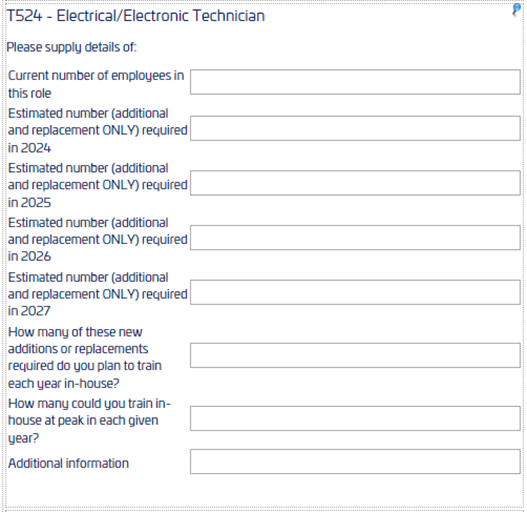
Sample Questions Asked In The Survey